
v3.6
This release strengthens data improvement workflows, cross-table checks, operational notifications, and AI-assisted work across the DQC Platform. It also includes important reliability improvements for large tables, exports, OData access, worker processing, and air-gapped deployments.
 New Features
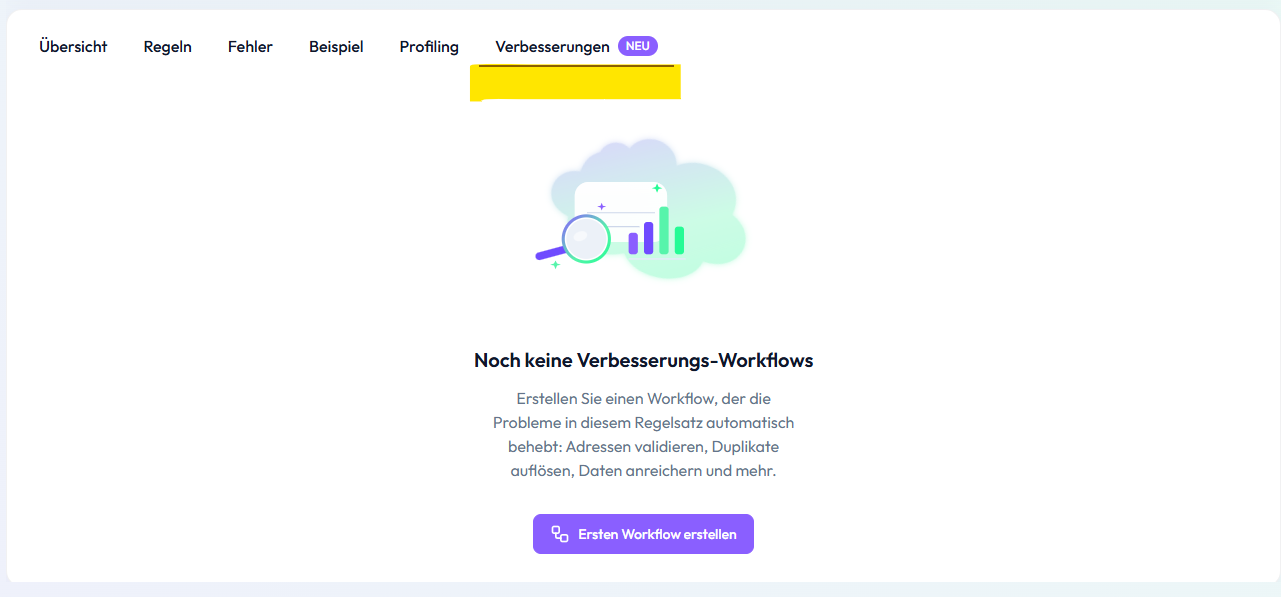
Multiple improvement workflows per ruleset
Rulesets now support multiple improvement workflows, making it easier to keep different remediation approaches side by side for the same quality checks.
Operational notifications in the Notification Center
The Notification Center now also supports operational platform updates, including stale connector syncs that need attention.
This continues the move toward one central place for relevant platform events, instead of spreading important updates across different surfaces.
Usage and consumption reporting API
Added API support for tenant and cluster-admin usage reporting.
This creates a clearer basis for monitoring platform consumption across tenants and environments.
Volume rule weighted moving average baseline
Volume rules now support a weighted moving average baseline with configurable bounds per check.
This helps detect unusual volume changes more reliably in time-dependent datasets.
PDF visual feedback
PDF extraction now gives clearer visual feedback while users work with documents.
 Improvements
DQ Assistants answer navigation questions more reliably
Assistants now provide correct in-platform navigation paths when users ask where to find a feature or setting.
More reliable cross-table previews and executions
Cross-table execution now applies ruleset scope, filters, and limits to the primary table only, avoiding incorrect filtering of joined data.
Large-path cross-table previews now compute joined and failed counts more accurately, restoring correct chart values.
Large cross-table rules are more reliable on big tables through pushed-down counts and samples, bounded issue samples, and fail-soft handling to avoid worker out-of-memory failures.
Equals checks without join keys now support bidirectional set equality.
Ruleset and preview polish
Ruleset check tables are more compact and now show skeleton loading states while checks load.
The preview node message bar has been corrected.
Ruleset check scope row limits are now also respected in sample previews.
Improved handling of ruleset and company rule tag fields.
Faster overviews and exports
The overview experience has been cleaned up and made faster.
Issue export is more reliable when dealing with nested columns.
Issue export description enrichment has been vectorized for better performance.
Connector and data access improvements
OData access is more robust
Connector state handling was fixed so connectors no longer remain stuck in loading in rare cases.
 Small improvements and bug fixes
All rows in a failing batch are now marked as failed instead of incorrectly marking them as completed.
Python nodes no longer raise a type error for valid syntax.
Profiling is more stable for inaccessible profiling data, UUID handling, and decimal correlation overflow.
Output rows in improvement workflows now explicitly show 'No improvement found' instead of leaving the result empty.
The sticky toast that could cover the group-create button can now be dismissed.
Some dashboard notifications were removed to reduce noise.
 Breaking Changes
None in this release