
v2.39
This release speeds up big workloads with asynchronous previews and high-throughput batching—cutting run times, reducing timeouts, and boosting stability. It also strengthens AI rule generation, segmentation, and connectors for smoother operations across the DQC Platform.
 New Features
A variety of new features has made it into the 2.39 release - see below!
Find / rules
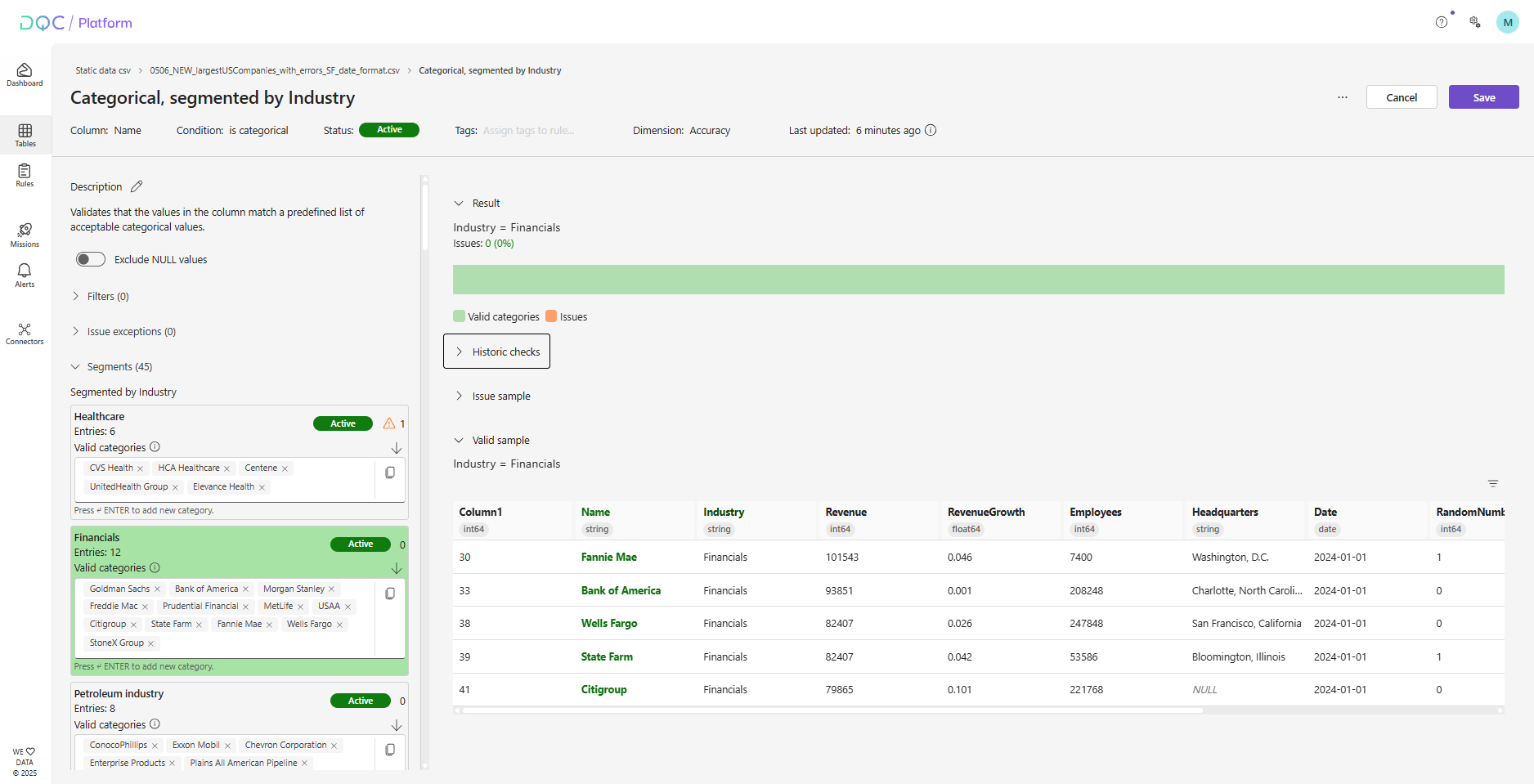
Sample segmentation for validation
Enables segmentation of samples and rule-specific “Valid” samples
Helps pinpoint where quality drifts occur and compare outcomes across cohorts
Export issues for a segment
Download issues filtered by any chosen segment to speed up triage and hand-offs to business owners
Ruleset import/export
Preserve metadata + confirmation toast
Exported and imported rulesets now keep their tags and quality dimensions, so filters, dashboards, and governance reporting work immediately after migration
An import confirmation toast provides instant feedback on success/failure of imported tags and dimensions, reducing guesswork and speeding up troubleshooting
Improvements
Python node: context files
Attach context files to Python nodes so remediation code can reference mapping files or samples
Improves reproducibility of fixes within DQC Platform improvement workflows
Asynchronous previews
Preview node in the improvement workflows now run asynchronously on the backend, keeping the UI responsive and reducing timeouts on large datasets
General
High-throughput batch processing
Improved parallelism with concurrent batches per worker and smarter pool limits to maximize throughput
Stabilized batching (fewer DB calls, cleaner logs, safer cleanup) for long-running workflows
Benefits: shorter end-to-end runtime, better resource utilization, and higher reliability under load
Scope: LLM rule, Document (PDF) processing, and improvement workflow
 Small improvements and bug fixes
Better error display across the platform to shorten troubleshooting
Fixed CSV UTF8-SIG import in improvement workflows
Python node coding assistant errors resolved; improved prompts
Connector & execution hardening
OData: OAuth2 for OData v4 and a more robust connector view (simplified parameters)
PDF connector refinements (linking, orientation/long names, safer deletes, Parquet write fixes)
AI rule generation: reliability & fallbacks
Adds a fallback SQL rule when the DQ-AI Assistant cannot confidently predict a rule, ensuring checks still run
Consolidates multiple rule agents on a shared base for consistent behavior and simpler evolution
Prompt improvements for custom SQL/Python/Regex rules reduce retries and clarify expected outputs
 Breaking Changes
None in this release