

60% better CRM data via DQC AI agent for data enrichment
Company profile
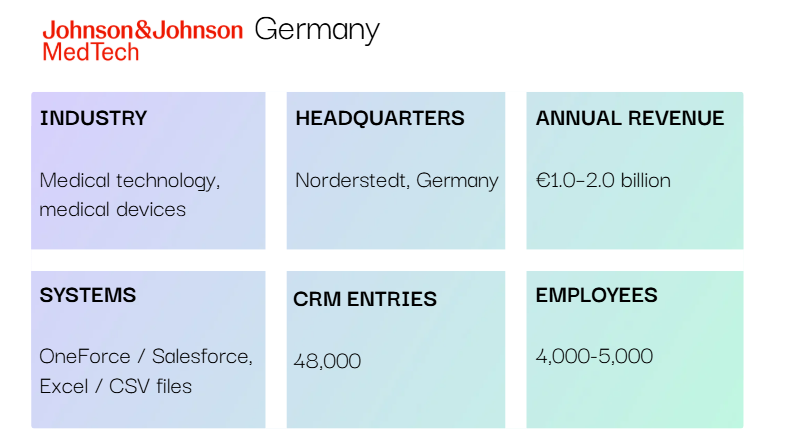 Johnson & Johnson MedTech Germany, a division of Johnson & Johnson, is a leading provider of medical technology solutions in the German healthcare market and part of a global organization driving healthcare innovation for over a century. The company offers a broad portfolio of surgical, orthopedic, cardiovascular, and vision solutions, as well as digital platforms and robotics to support modern healthcare. With operations across Germany and integration into a global network spanning over 60 countries, Johnson & Johnson MedTech combines deep clinical expertise with strong local market presence.

Initial situation
The CRM contact data landscape at Johnson & Johnson MedTech was characterized by significant quality challenges that limited commercial effectiveness. The existing dataset comprised around 48,000 contact records, many of which were incomplete, outdated, or unreliable.
Around 40% of records lacked essential contact information
Approximately 25% of existing data was outdated
eMail campaigns experienced high bounce rates and limited reach
As a result, consistently reaching the right stakeholders was difficult. Effectiveness of sales and marketing campaigns declined, and personalization was limited by missing or incorrect data.
At the same time, people spent significant effort on manual data tasks (e.g., searching for contacts, correcting errors, and resolving communication issues), reducing the time available for customer-facing activities.
More fundamentally, data quality was not managed as a structured, ongoing process. Fragmented ownership and reactive fixes made it difficult to maintain a reliable CRM data foundation over time.
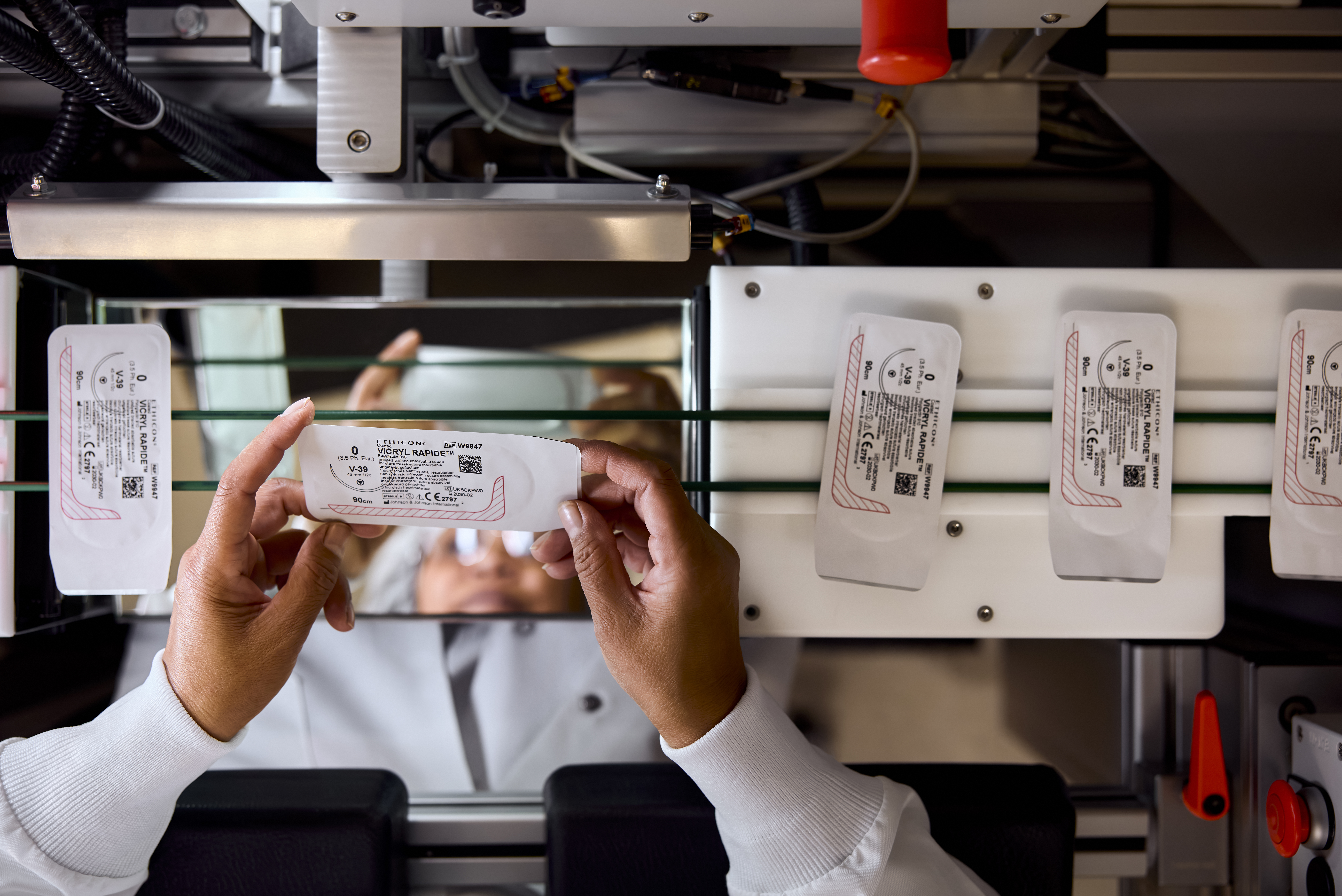
Deep Dive
Together with DQC, a three-step approach was defined: Clean, Enrich, and a future Sustain phase to ensure long-term impact.
Clean
The existing data was streamlined semi-automatically with the DQC Platform by correcting core contact attributes and activating additional contacts:
11,000 contact details were corrected
14,000 new active contacts were made usable
This created a reliable baseline and improved reachability for campaigns.
2. Enrich
The CRM dataset was systematically enriched using an AI-driven agent, without needing a system integration or using any IT resources.
In the German project:
30,000+ phone numbers added or corrected
4,000+ eMail addresses added or corrected
3,000+ personalized salutations added or improved
10,000+ postal addresses standardized or completed
A key focus was the standardization of salutations and title structures across multiple fields, reducing inconsistent formats (e.g. “Herr”, “Hr.”, “Dr.”) to a clear logic. Missing values were addressed through inference based on existing data.
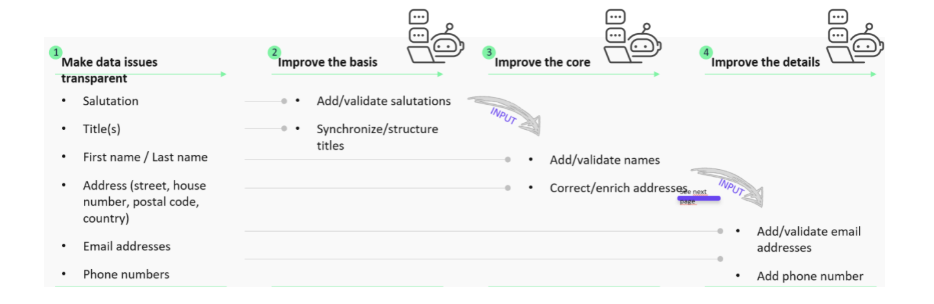 The enrichment followed a structured logic across dedicated Improvement Workflows: starting with harmonizing base attributes (salutation, title), then improving core data through name identification using salutation, title, hospital, and eMail patterns, and address validation via geocoder and web sources.
The final step focused on the most complex attributes within separate Improvement Workflows, using website search, domain matching, and public source validation to identify professional eMail addresses and phone numbers.
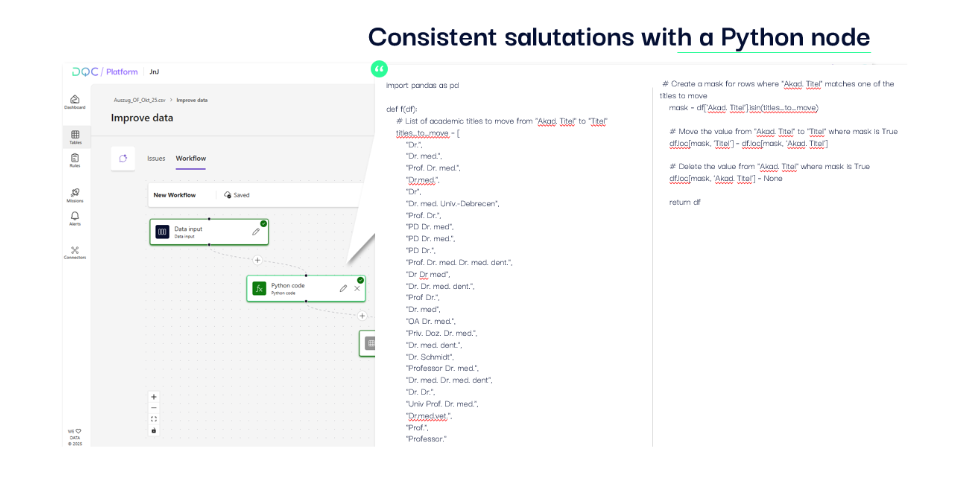 All steps were embedded in a scalable, agent-based workflow and closely tied to real CRM interactions.
Impact
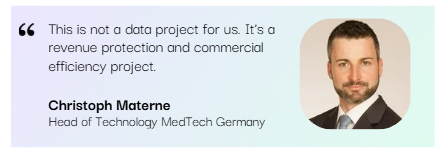
By systematically improving CRM contact data quality across around 48,000 CRM contact records, over 57,000 data points such as phone numbers, email addresses, salutations, and postal addresses were enhanced, translating into an estimated €3–8 million in business value in Germany alone (benchmark assumptions Gartner, IBM, Salesforce, HBR).
Beyond the initial improvement, the approach enables scalable impact across EMEA, unlocking substantial additional value while establishing a strong foundation for sustainable, data-driven sales and marketing operations.

Outlook
Following the German project, the next step is to establish a dedicated “Sustain” phase to turn the one-time improvements into a continuous, scalable process. This includes embedding data quality more firmly into daily sales workflows, increasing the level of automation in data enrichment, and strengthening ownership across business teams. Concepts such as AI supported data quality assistants (e.g., within Microsoft Teams), clear responsibility models, and continuous feedback mechanisms are being explored to ensure long-term data quality.
At the same time, the project provides a strong foundation for scaling the approach to additional countries and regions. It already demonstrates a clear path toward broader rollout and highlights that data quality should not be treated as a one-time initiative, but as an ongoing capability within a modern commercial and CRM organization.
&w=3840&q=75)