

Automatic creation of new product data using the DQC Platform
Balluff
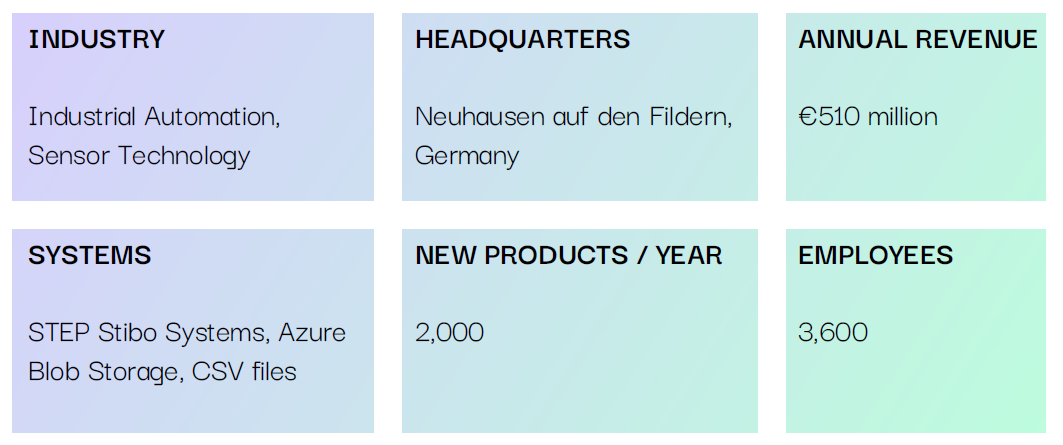 Balluff GmbH, headquartered in Neuhausen auf den Fildern, is a family-owned company in its fourth generation that has been in operation since 1921 and is one of the world’s leading specialists in sensor technology and industrial automation.
The company develops sensor, identification, and image processing solutions, as well as network technology and software for a wide range of automation requirements. With 38 subsidiaries and a presence in 61 countries, Balluff combines technological depth with international market proximity.
Initial situation
When creating new products in the PIM, much of the data was previously enriched manually. Employees had to look up information in spreadsheets, copy values from similar existing products, use static inheritance, or ask product specialists and colleagues about missing attributes. While this process generally worked, it was highly dependent on specific individuals, prone to errors, and consumed a significant amount of time in day-to-day operations.
From Balluff’s perspective, this approach is no longer appropriate: manual maintenance was too time-consuming and, at the same time, prone to errors. However, for a company with high demands on technical product and material data, ensuring high data quality is crucial. Only when attributes are maintained in a complete, consistent, and traceable manner can products be efficiently created, approved, and reliably used in downstream processes.
This is particularly true for responding promptly to customer inquiries. Customer inquiries need to be answered within 24 hours, which is not possible with a largely manual approach.
Therefore, the company sought an approach that would largely automate monotonous data entry, systematically leverage existing product knowledge, quickly integrate new entries into the PIM, and still leave technical verification in human hands. This is where DQC supported Balluff.

Solution
In collaboration with DQC, Balluff has further developed the product creation process so that the DQC Platform is used as an intelligent component in data enrichment. The existing tools were adapted in collaboration with DQC, an automated interface was established, and the approval process was revised. The goal was to derive usable logic from already approved existing products and apply it to new products.
Essentially, the DQC Platform supports and automates the enrichment of new product data. The necessary logic is derived from existing products; additionally, Balluff defines quality rules and technical rules in the DQC Platform that are applied during automated data enrichment. As a result, significantly more data for new products becomes available in a short time, while humans focus on inspection, rework, and improvement.
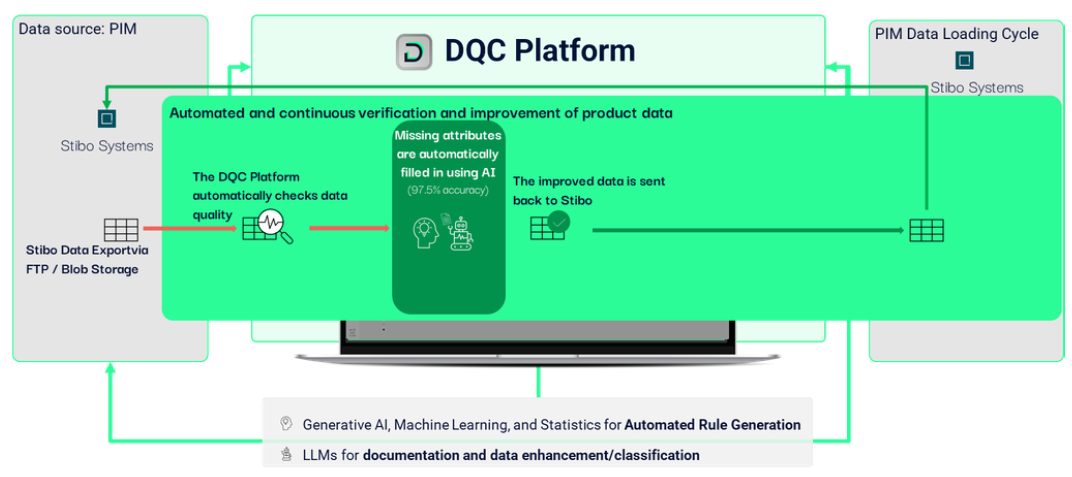 To implement this, several components were established in collaboration with DQC:
Automated interface between PIM and the DQC Platform
Weekly updates of approved products to maintain an up-to-date database
Definition of quality rules and additional business rules in the DQC Platform
Revision of the approval process in PIM at Balluff
The operational process for automatically creating new product data is clearly structured:
A new product is created in the PIM within the appropriate product structure.
The product is populated with basic information and submitted for initial release.
The data is transferred to the DQC Platform.
In the DQC Platform, data is automatically enriched based on existing products as well as defined quality and business rules.
The enriched data is transferred back to the PIM and displayed in a review view.
A human user performs the final review, approval, and any necessary rework.
Final products are transferred to the DQC Platform as new reference data.
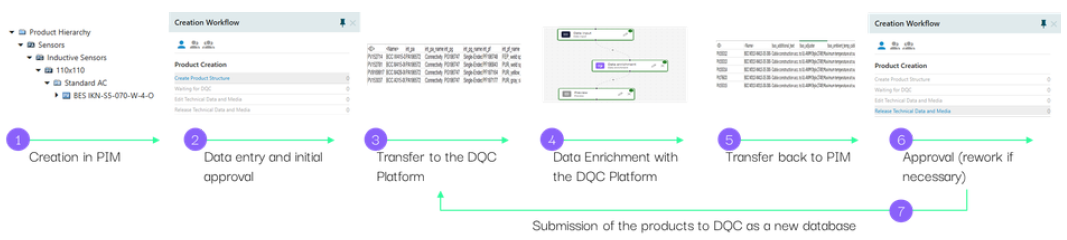 A key factor in our success is the continuous updating of the database. To this end, products approved each week are transferred from the PIM to the DQC Platform. This reference data is used to derive patterns, rules, and enrichment logic for future materials. The system thus learns not only from static rules, but also from the actual product reality at Balluff.
Quantity (turnaround time) and quality are often mutually exclusive—but by using this new tool/process, we’ve managed to combine the two and improve both at the same time.”
Bastian Tausch, Product Owner Digital TEC
Impact
Automated new product creation has two key positive impacts on day-to-day operations.
First, automating the new product creation process enables Balluff to prepare and deliver quotations up to 20 times faster in response to customer requests. The time required to prepare a quote is reduced from several weeks to less than 24 hours. This makes interactions with customers significantly more agile, efficient, and responsive.
Second, subject matter experts spend significantly less time entering data and now only need to validate the generated new product proposals. Approximately 80% of the time previously spent on this task is saved. This allows them to focus the majority of their time on higher-value tasks.
Outlook
Now that all product groups have been integrated into this process, a consistent logic and comparable process are being implemented for material creation (from SAP). This enables efficient automatic population of master data in this area as well.
&w=3840&q=75)