
S/4HANA concentrates decades of process logic into a single platform. That power also concentrates risk: small data defects propagate quickly across finance, supply chain, and analytics. A modern data quality approach treats S/4HANA like an always-on production system, i.e. observed continuously, not inspected episodically.
Where issues actually arise (and why they are hard to catch; selected examples)
Complex referential webs: One missing material view can break planning, pricing, or MRP—even when the material technically “exists.”
Local optimizations, global side effects: A quick master-data fix for one plant or company code can create inconsistent behavior elsewhere.
Volume + velocity: High-throughput transactional tables make manual sampling ineffective; defects hide until period close or audit.
Hybrid landscapes: S/4HANA rarely stands alone—MDM, PLM, eCommerce, data lakes, and BI tools all amplify bad records if not checked at the source.
Concrete fault lines in S/4HANA
Master and transactional data both matter—and they interact.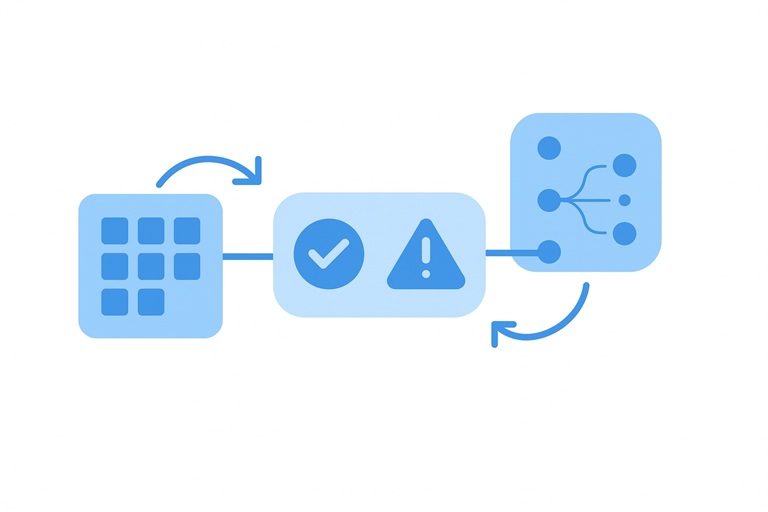 There are many examples - but just to name a few:
Material master (MARA, MARC, ...)
Completeness and coherence: MARA.MATNR must have required plant views in MARC; UoM/weight (MEINS, BRGEW/NTGEW) consistency
Coded domains: valid MATKL, DISPO, procurement type combinations
Z-Fields
Business partner, vendor, customer (BUT000, LFA1/LFB1, KNA1/KNVV, ...)
Duplicate detection via VAT/Tax ID + fuzzy name/address
Required company-code or sales-area extensions present for active entities
Format rules for email/phone and country-specific postal codes
Finance (ACDOCA, BKPF/BSEG, TCUR*, ...)
Period controls: postings only in open periods; document status alignment
Balancing: debits/credits by ledger, company code, currency
Master alignment: exchange-rate consistency vs. TCUR*; valid cost centers (CSKS/CSKT)
Order-to-Cash & Procurement (VBAK/VBAP, LIKP/LIPS, VBRK/VBRP, EKKO/EKPO, ...)
Referential integrity: every item has a valid header; delivery/billing completeness
Sanity checks: extreme unit prices, UoM mismatches, unusual order volumes (baseline vs. history)
Cross-master links: EKPO materials exist in MARA; purchasing org and plant consistency
Manufacturing & Logistics (MSEG, MBEW, AFKO/AFPO, ...)
Inventory coherence: movements reconcile with valuation; negative on-hand detection
Effectivity and BOM/routing alignment; unit compatibility
What “modern” principles and requirements look like
Continuous monitoring over periodic projects: Always-on profiling, drift detection, and trend tracking across both master and transactional data.
Prevention as well as detection: Data-quality rules act as circuit breakers in interfaces and pipelines to stop propagation.
Explainable, adaptable business rules: Thresholds derived from history, automatically recalibrated to business seasonality and change.
Domain-friendly workflow: Issues routed to business owners (not only IT queues) with example rows, impact radius, and suggested remediations.
System-spanning visibility: Checks run in SAP and at the edges (staging, analytics, API ingress), so fixes happen where they matter.
AI assistance, not opacity: Natural-language to rule (“End date after start date for service contracts”), suggested checks from table semantics, and guided merges for duplicates, usable by domain experts and not only for SAP developers.
AI-supported data improvements
Modern data quality isn’t just detection, but with agentic workflows, it includes automated data standardization, correction, and enrichment. AI helps normalize codes and units to agreed domains, propose safe corrections (e.g., valid UoM, currency, or plant codes) with human control, and enrich gaps from authoritative sources such as TCUR*, CSKS/CSKT, or reference master records. It clusters exact/near-duplicates across names, addresses, and tax IDs so business users can merge confidently, and it learns from accepted fixes to refine future suggestions. The result is a controlled, auditable improvement loop: cleaner, standardized master data that drives fewer transactional errors. In short, improvements that stick.
How this complements classic governance
Approval workflows and golden-record stewardship remain essential. They ensure changes are authorized and traceable. A modern data-quality layer sits alongside them to provide continuous measurement, anomaly detection, and preventative guardrails, especially for high-volume transactions and cross-system flows that governance workflows don’t observe in real time.
How our customers use the DQC Platform
DQC Platform implements the above principles for S/4HANA and adjacent systems: auto-profiling, suggested rules, anomaly detection, and circuit breakers across MARA/MARC, ACDOCA/BKPF/BSEG, VBAK/VBAP, EKKO/EKPO, MSEG/MBEW, and more. It routes issues to business owners in Teams/Slack/E-mail, supports both master and transactional data, and lets domain experts author and maintain checks. Yes, liberating the work from SAP developers.
As a customer describes it:
“DQC is the most pragmatic, effective and intelligent starting point for continuous data quality in S/4HANA.”
#MusicToOurEars
&w=3840&q=75)